
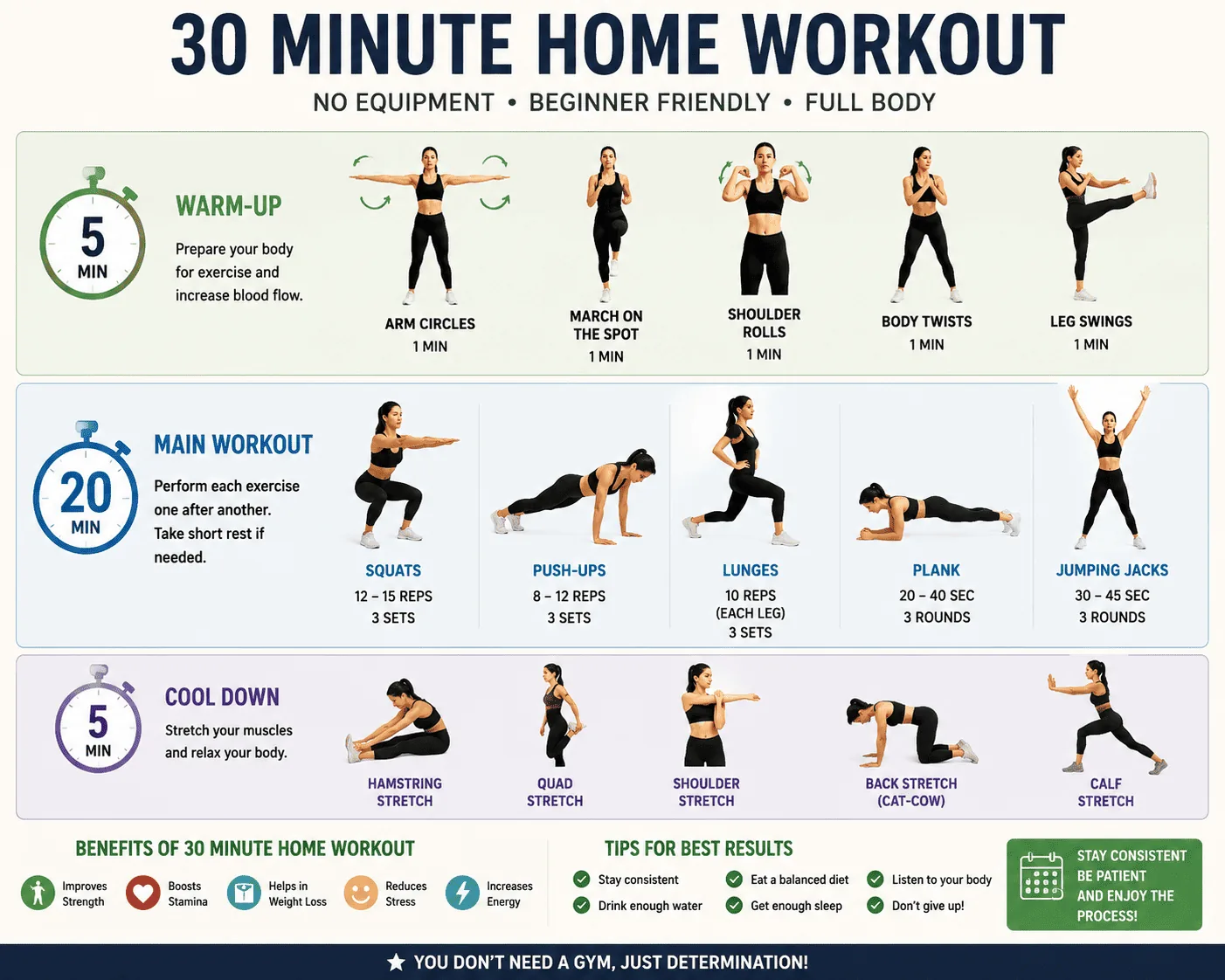
- 5 min — Warm-Up
- 20 min — Main Workout
- 5 min — Cool Down
A 30 minute home workout — 5 minutes warming up, 20 minutes of squats, push-ups, lunges, planks, and jumping jacks, then 5 minutes cooling down — is enough to build strength and support weight loss when you stay consistent. No gym or equipment required.
Have you ever tried to start exercising, only to keep pushing it to “tomorrow”? Between work and daily responsibilities, it’s genuinely hard to find time. The good news: you don’t need hours at the gym. A focused 30 minute home workout is often enough — and small, consistent steps like this are far easier to stick with than an all-or-nothing plan, whether you’re just starting out or simply want something simple.
A full-body workout is a training session that targets every major muscle group — legs, core, chest, arms, and shoulders — in one sitting, rather than splitting muscle groups across separate days.
- Why a 30 Minute Workout Is Effective
- A Simple 30 Minute Home Workout Plan for Beginners
- Getting the Four Movements Right
- Advantages of Working Out From Home
- Tips for Making It a Daily Routine
- Why You Can’t Spot-Reduce Belly Fat
- Core Exercises Worth Doing — and What They Actually Do
- Eating for a Deficit Without Following a “Plan”
- Frequently Asked Questions
Why a 30 Minute Workout Is Effective
Thirty minutes is long enough to train every major muscle group and short enough that you will actually do it on a Tuesday when you are tired. That second part is what makes it work — a perfect 90-minute session you skip four times a week loses to a 30-minute one you finish.
Most beginners are not limited by time. They are limited by how hard it feels to start. A fixed, short block removes the decision: you know exactly when it ends before you begin.
There is a physiological reason too. Untrained muscles respond to very little stimulus at first. For the first two or three months, bodyweight squats, push-ups and planks are genuinely enough to build strength — you do not need a longer session until your body stops responding to a shorter one.
A Simple 30 Minute Home Workout Plan for Beginners
Starting out can feel intimidating, but the good part is you don’t need complicated equipment or a personal trainer to begin. A few simple, well-chosen moves are enough to build an effective full-body routine.
- Warm-Up (5 minutes). Prepare your muscles with arm circles, marching on the spot, and shoulder rolls. This makes the rest of the session easier and safer.
- Main Workout (20 minutes). This is where the full-body work happens — see the five exercises below.
- Cooling Down (5 minutes). Stretch and let your heart rate settle. This helps your body recover and keeps you comfortable for your next session.
The 5 main-workout exercises
Squats
Trains the leg muscles and is one of the best exercises to lose belly fat fast, since it works large muscle groups.
Push-Ups
Builds strength in your arms, shoulders, and chest.
Lunges
Develops balance while training the legs from a different angle than squats.
Plank
Strengthens your core — a key move if your goal is a flatter stomach.
Jumping Jacks
Raises your heart rate and adds a cardio element to the session.

If you’re a beginner, start slowly and focus on learning each movement properly rather than rushing through repetitions.
- 5 minutes warm-up, 20 minutes main workout, 5 minutes cool-down
- Five moves — squats, push-ups, lunges, plank, jumping jacks — cover the whole body
- Form first, repetitions second, especially when you’re new to this
Getting the Four Movements Right
Almost every beginner routine comes down to a squat, a push, a hinge and a plank. Doing them badly is how people end up with sore knees and a sore lower back, and then decide training is not for them.
Squat. Feet about shoulder width, toes turned slightly out. Push your hips back first, then bend the knees. Go as low as you can without your lower back rounding — that point is your depth for now, and it improves on its own.
Push-up. Hands under your shoulders, body in one line from head to heels. If your hips sag, put your hands on a chair or a wall instead. A clean incline push-up builds more than a collapsing floor one.
Hip hinge (glute bridge). Heels close to your bum, drive through the heels, squeeze at the top. You should feel this in the glutes and hamstrings. If you feel it in your lower back, you are arching instead of squeezing.
Plank. Elbows under shoulders, ribs pulled down, bum squeezed. Thirty good seconds beats two shaky minutes. If your lower back is doing the work, end the set.
Advantages of Working Out From Home
No commute, no waiting for equipment, no membership you feel guilty about. For a beginner the biggest advantage is quieter than that: nobody is watching, so you can take the full rest you need and stop a set that feels wrong.
Home training also removes the most common excuse. A session that needs a bag, a drive and a changing room has four points where it can fall apart. A session that needs a clear patch of floor has none.
The trade-off is real and worth naming. At home nobody corrects your form, and there is nothing to progress onto once bodyweight gets easy. Both are solvable — film a set on your phone and compare it against a reference, and add a pair of adjustable dumbbells when squats stop feeling like anything.
Tips for Making It a Daily Routine
Pick a time and keep it fixed for three weeks. Not the best time — the most repeatable one. Most people who stuck with training did not find motivation, they found a slot nothing else competes for.
Lay the mat out the night before. It sounds trivial, and it is the single change that most reliably survives a bad week.
Track sessions, not results. A tick in a calendar for every day you trained gives you something to hold on to, while the scale stays flat for weeks and quietly talks you out of it.
Plan the missed day before it happens. One skipped session is normal; what ends routines is treating it as proof the routine failed.
Why You Can’t Spot-Reduce Belly Fat
This is the part most workout articles get wrong, so it is worth being direct: no exercise removes fat from one specific place. Crunches build the muscle underneath the fat. They do not burn the fat sitting on top of it.
Fat comes off the whole body when you are in a calorie deficit, and where it comes off first is largely down to genetics and sex. For many people the midsection is the last place to change — which is exactly why “lose belly fat fast” content keeps selling. The thing it promises is the thing that takes longest.
What actually moves the number: a modest, sustainable calorie deficit, enough protein to hold on to muscle while you lose fat, resistance training two or three times a week, and sleep. None of those is fast, and all four together are what people who succeeded actually did.
Core training still belongs in your week. A strong midsection protects your lower back and makes every other movement safer. Just expect strength from it, not a flatter stomach on its own.

Core Exercises Worth Doing — and What They Actually Do
Given the above, here is the honest version of a core list. These earn their place because of what they build, not because of where the fat goes.
Anti-extension — plank, dead bug, hollow hold. These teach your midsection to stop your lower back arching under load. It is the group most beginners skip and most need.
Anti-rotation — bird dog, side plank, and a Pallof press if you have a resistance band. These stabilise you when force comes from one side, which covers most of real life.
Flexion — crunches, mountain climbers, leg raises. Fine to include, genuinely useful for the muscle, and by far the most over-prescribed of the three.
Two or three of these, two or three times a week, five to ten minutes. Beyond that you get diminishing returns and lose time from the compound movements that do more for you.

Eating for a Deficit Without Following a “Plan”
Most diet plans fail for the same reason: they are a temporary set of rules, so the results last exactly as long as the rules do.
The mechanics are not complicated. Eat slightly less than you burn, get enough protein to keep the muscle you are training for, and build meals you would still be willing to eat in six months. A deficit of roughly 300–500 calories a day is enough for steady loss without wrecking your energy for training.
Three changes do most of the work, in this order: get protein into every meal, drink your calories less often, and cook one more meal a week than you currently do. None of that needs a plan document.
If you are pregnant, managing a medical condition, or taking medication, speak to a doctor or a registered dietitian before changing how you eat or train. This article is general information, not personal medical advice.

Bottom Line
Fitness doesn’t need a complete lifestyle overhaul. Small, consistent steps often produce the biggest results.
It really comes down to showing up for your 30 minutes and building the habit from there. All you need is the motivation to begin — and to keep going.
Related guides
Weight LossBest Weight Loss Diet Plan for Beginners
Belly FatHow to Lose Belly Fat Fast: 7 Proven Tips
Exercises10 Best Exercises to Lose Belly Fat
Frequently Asked Questions
Is 30 minutes of exercise enough to remain fit?
Yes, a regular 30 minute home workout, done consistently, can meaningfully improve your fitness and overall health.
Is a 30-minute home workout good for beginners?
Yes, a beginner workout at home helps you learn the basic movements safely before adding intensity or extra sets.
Can you do a 30-minute home workout without any equipment?
Yes. Bodyweight moves like squats, push-ups, lunges, and planks work every major muscle group without any equipment.
How often should you do a 30-minute workout at home?
Most beginners do well with 3 to 5 sessions a week, adjusting frequency to their fitness level and recovery.
Can a 30-minute workout help with weight loss?
Yes — regular exercise paired with a sensible weight loss diet plan supports steady, sustainable weight loss.
What is the best weight loss diet plan to pair with this workout?
A simple diet plan built on whole foods, a moderate calorie deficit, and enough protein pairs well with this routine and supports steady weight loss.
What are the best exercises to lose belly fat fast?
Full-body moves like squats, planks, lunges, and jumping jacks are some of the best exercises to lose belly fat fast, since they burn calories while building core strength.